NEWS FLASH - March 2020 As you will understand, with the Covid-19 pandemic shutting down most normal business, we are not able to despatch orders for the time being. Thank you for your patience. We shall resume operations as soon as we possibly can.
Brightspark Magnetos
NEW ...
Take a look
at some of the equipment we use in our workshop for magneto servicing
and overhauls.
Is it true that in an emergency an external condenser hooked up to a brush on
the kill button will work?
If the original condenser has failed open circuit this
might work, and there are tales out there of people running for years with this
bodge. But it is a bodge. Furthermore, many condensers don't fail open circuit.
Tests at Brightspark, reported below, have shown how poorly an
externally-mounted condenser connected to the cut-off brush performs, compared to a
correctly installed one. Even if the engine does run, caution should be
exercised. There is likely to be much more arcing at the CB points than is good for
them, and the ignition timing is likely to be severely retarded.
Bear in mind that, with an external condenser, the
condenser current has to flow not only through the cut-out brush, but also in
series through the earth brush in order to return to the magneto armature.
Neither the cut-out brush nor the earth brush was designed to carry the heavy
condenser current on an ongoing basis.
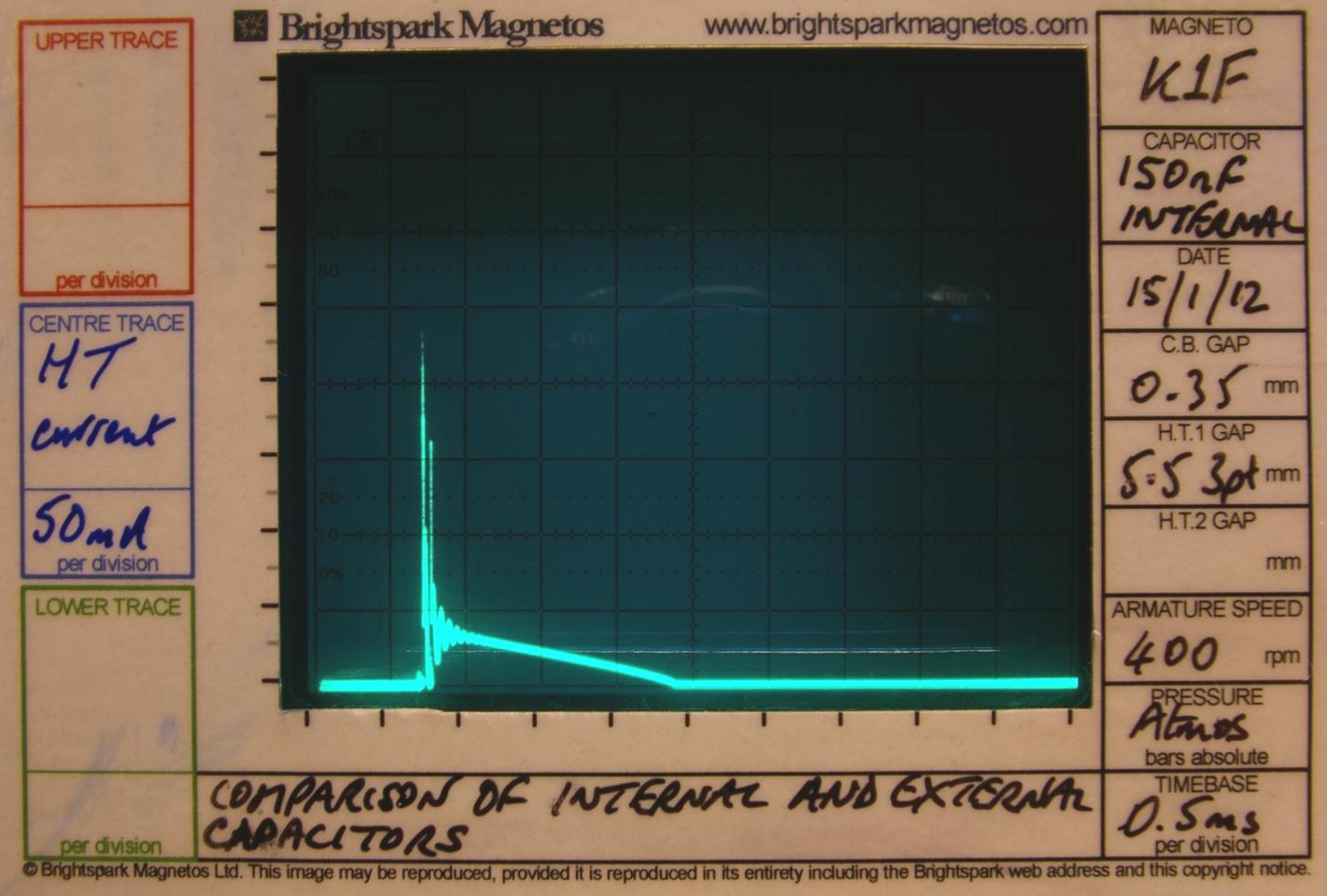
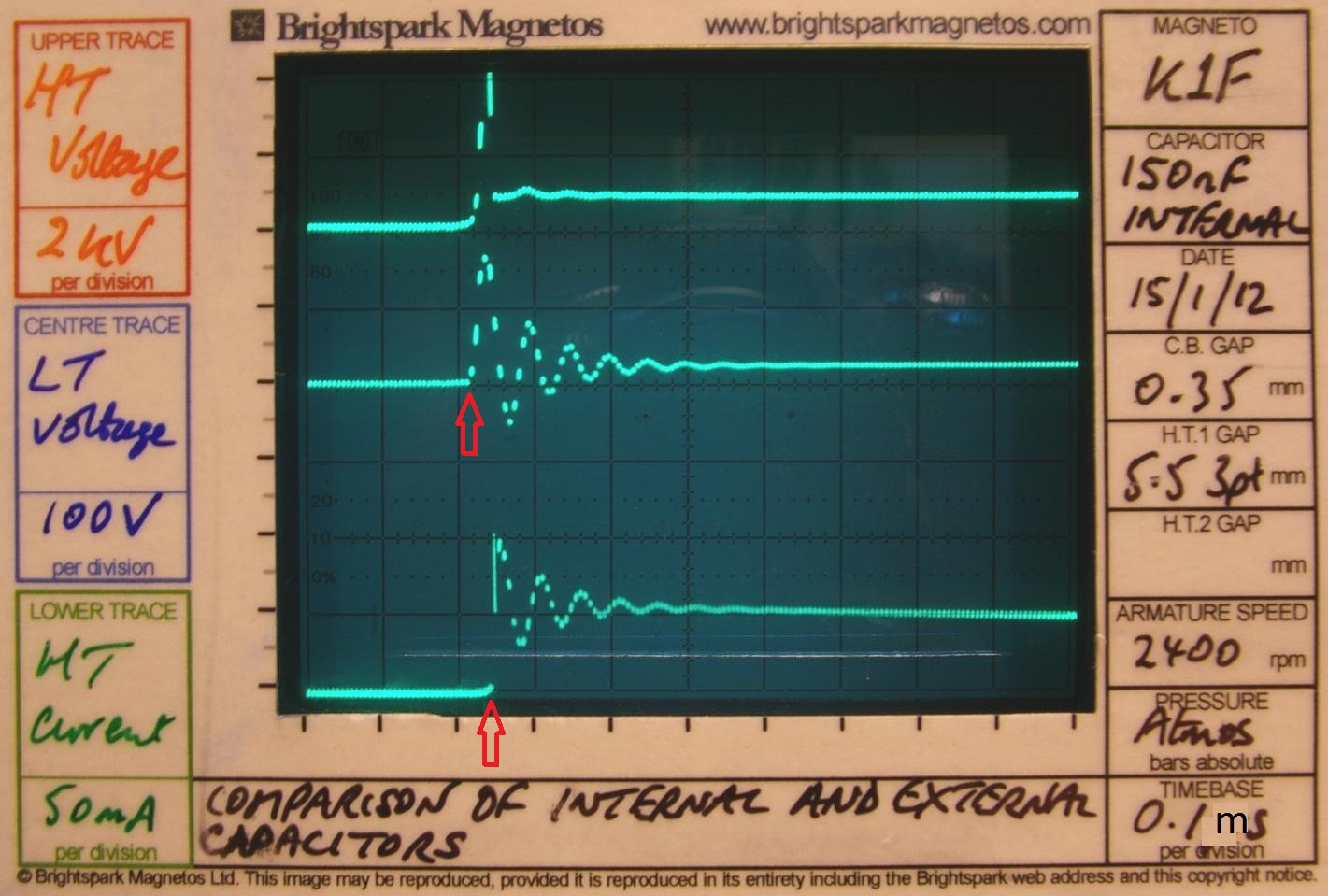
Internal 150nF condenser
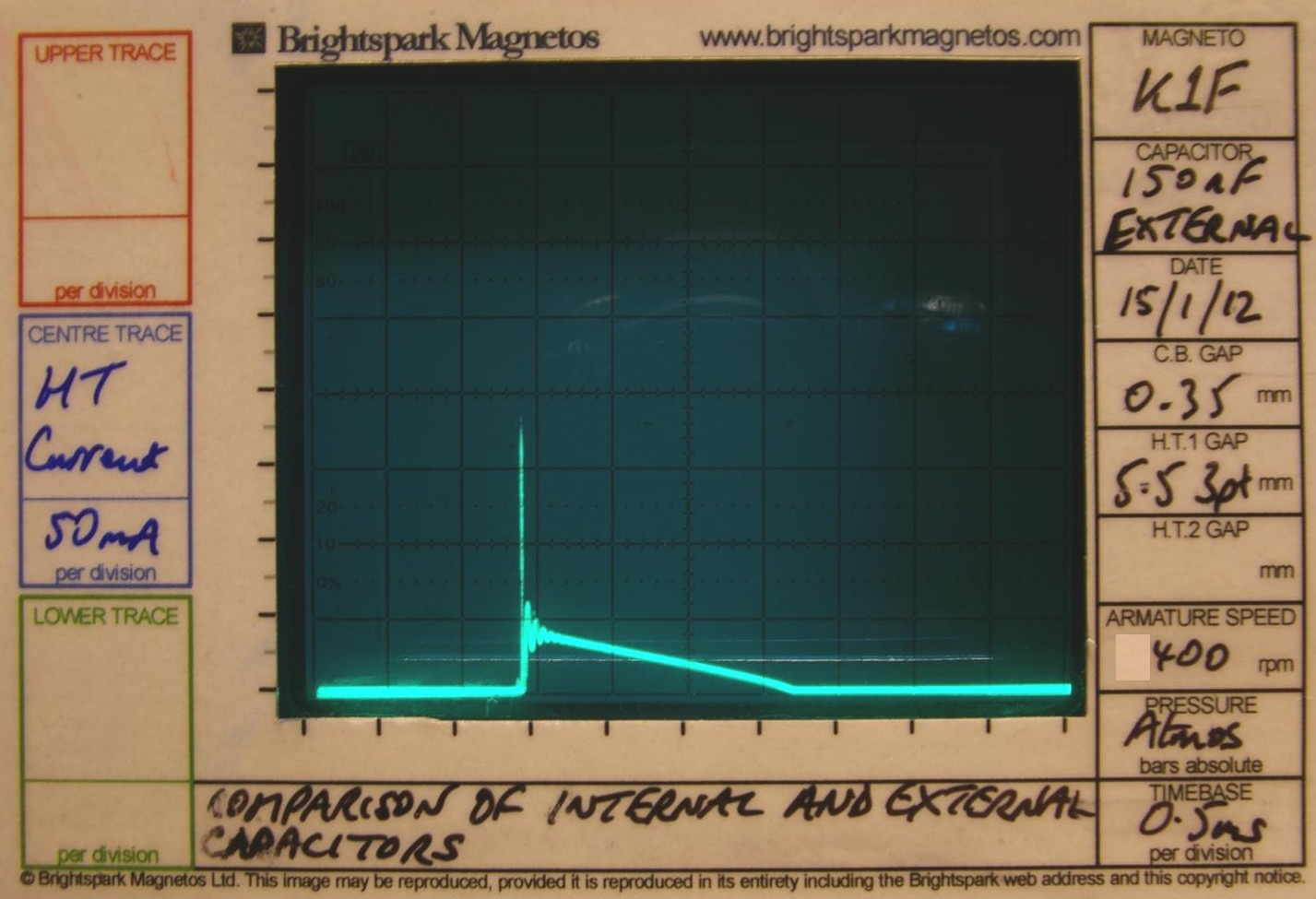
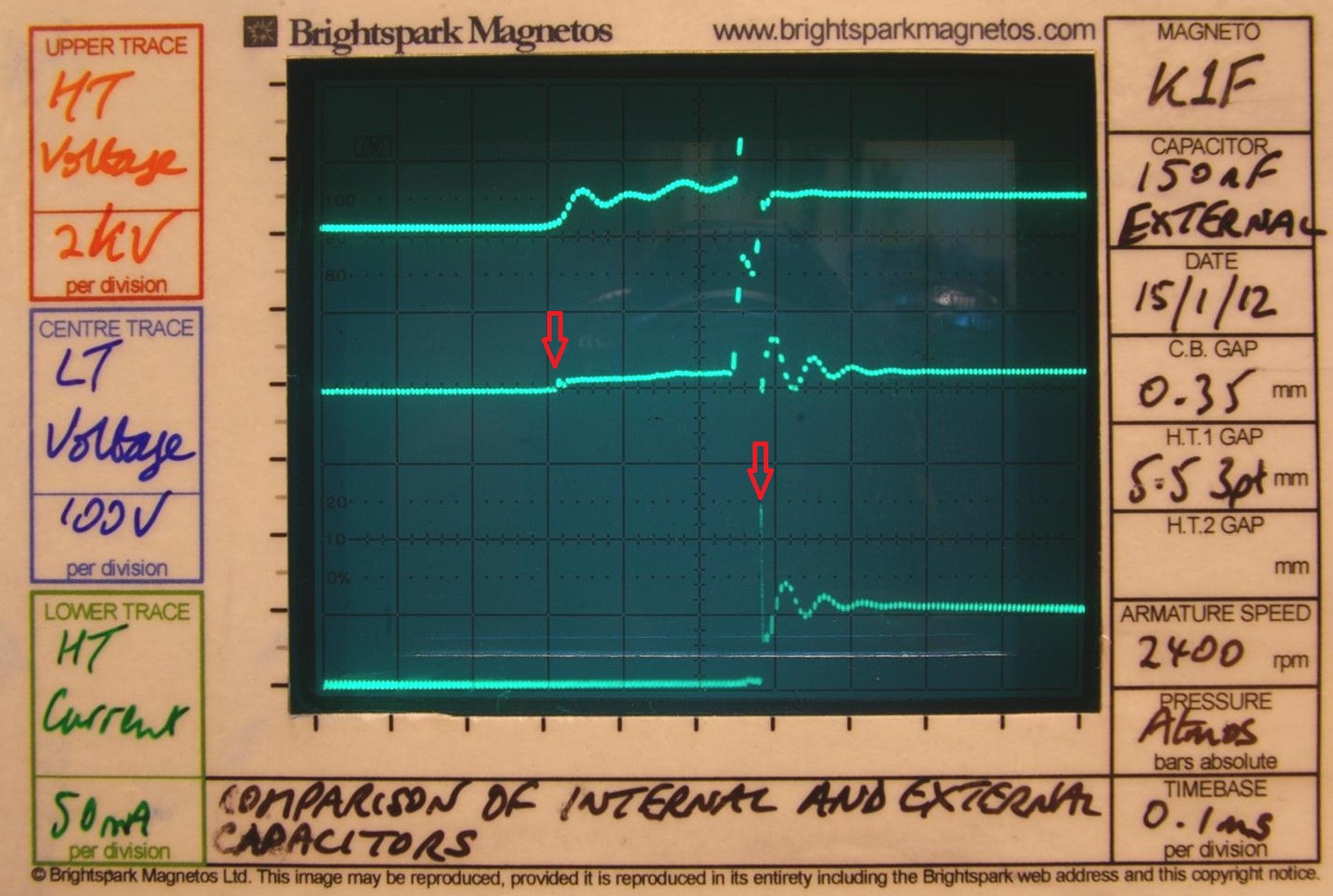
External 150 nF condenser
connected via
cut-out brush
Video clips of CB arcing
during run-up to 3400 armature rpm (6800 crankshaft rpm) and back again
Internal condenser: Pinpoint sparking.
External condenser: Substantial arcing.
HT current at 400 armature rpm (800 crankshaft rpm)
Internal condenser: Initial peak HT current
is about 230 mA.
Initial DC component of HT current is about 40 mA.
External condenser: Initial peak HT current
is reduced from about 230 mA to about 180 mA.
Initial DC component of HT current is about 40 mA.
Ignition spark delay at 400 armature rpm (800 crankshaft rpm)
Internal condenser: Delay between contact
breaker opening and ignition spark striking is about 50
µs, which equates to about 0.24° at the
crankshaft.
External condenser: Delay between contact
breaker opening and ignition spark striking is about 320
µs, which equates to about 1.5° at the crankshaft.
HT current at 2400 armature
rpm (4800 crankshaft rpm)
Internal condenser: Initial peak HT current
is about 240 mA.
Initial DC component of HT current is about 60 mA.
External condenser: Initial peak HT current
is reduced from about 240 mA to about 160 mA.
Initial DC component of HT current is reduced from about 60 mA to about 33 mA.
Ignition spark delay at
2400 armature rpm (4800 crankshaft rpm)
Internal condenser: Delay between contact
breaker opening and ignition spark striking is about 30
µs, which equates to about 0.9° at the crankshaft.
External condenser: Delay between contact
breaker opening and ignition spark striking is about 260
µs, which equates to about 7.5° at the crankshaft
... considerable.
Footnotes:
In the tests with the external condenser, sparking
was unreliable. Also, there was a great amount of variation between the
voltage and current waveforms obtained for one spark, and those for the
next. The waveforms shown in the right-hand column are, however, fairly
representative.
On the Brightspark rig, for the cut-out brush
we use an HT brush and HT brush spring in a brass holder fixed in the end
cover. The resistance at standstill between the CB centre screw and the
brass holder was measured to be 1.5Ω.
By contrast, the measured resistance of the standard earth brush assembly
used in the magneto on the rig was substantially higher, about 15Ω.
 Brightspark Magnetos