|
The spring rate and preload of the springs in a magneto ATD
are important, but perhaps not as important as you might initially think.
With a magneto ATD, the speed dependent advance that the
bob-weights are trying to cause is being opposed not only by the ATD springs,
but also by the load placed on the ATD by the magneto. The magneto load is also
dependent on speed, and in the whole scheme of things, it is quite substantial.
It is that load which enables the magneto to generate its electrical output and
also produce all its losses (e.g. windage, eddy current losses, bearing losses, friction
at the contact breaker and oil seal, etc.). By comparison, in a distributor with centrifugal advance for a
coil ignition system, the only load on the auto advance mechanism is the
friction of the contact breaker and a little bit of windage around the cam and
rotor arm.
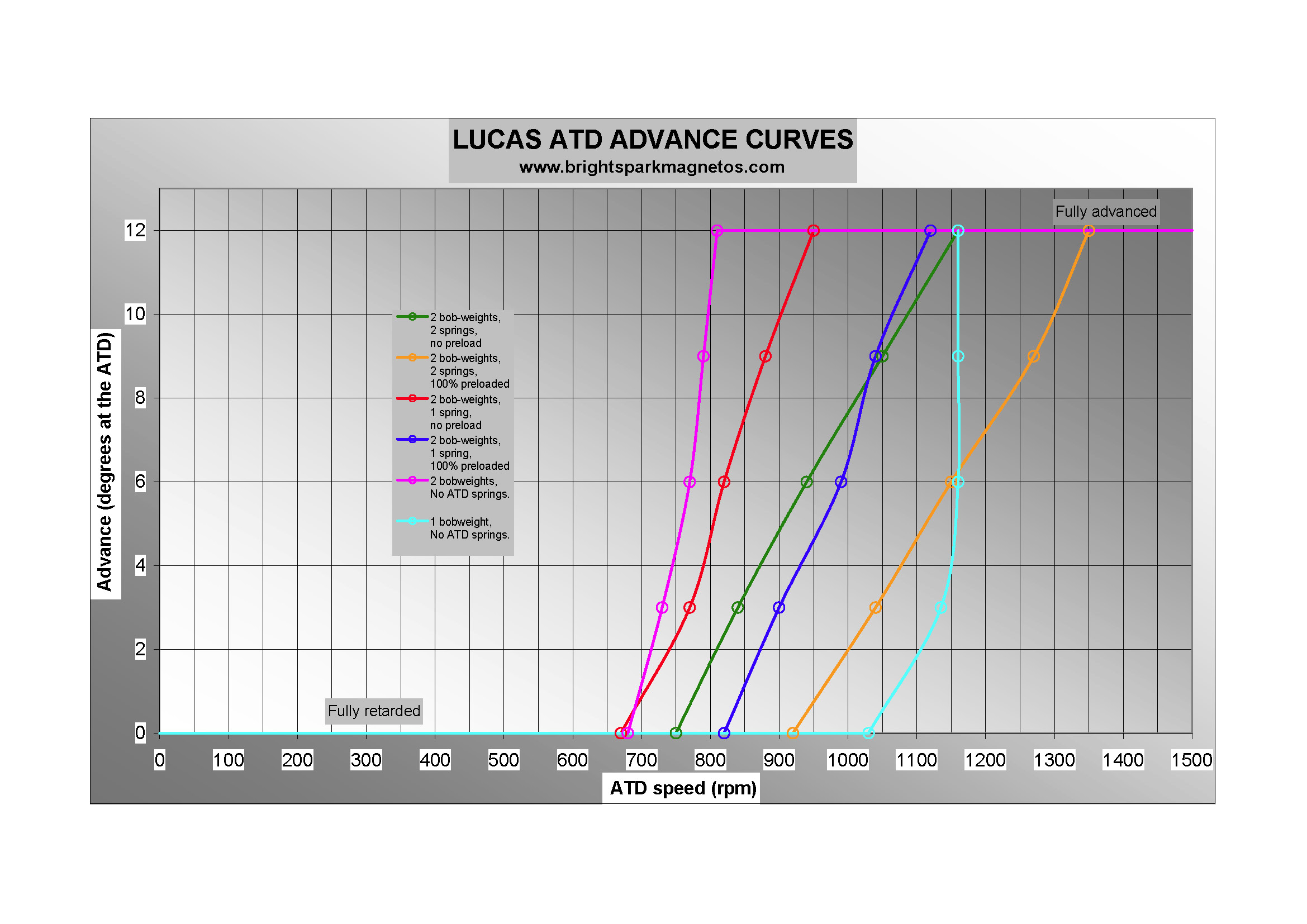
The graph shows various advance curves for a Lucas ATD in good condition when driving a
Lucas K2F magneto on one of our test rigs using a rotary gap so that the angular
positions of the ATD's input member at which the sparks occurred could be
readily ascertained. The ATD spring(s) were brand new pattern parts.
For the
green line, the springs were adjusted so that they only just became slack in the
fully-retarded position of the ATD i.e. 'no preload'. As can be seen, the ATD
remained fully retarded up to 750 rpm at the magneto (1500 engine rpm on a
four-stroke engine), and then progressively moved to fully advanced by 1160 rpm
at the magneto.
The orange line shows the operation with the springs adjusted
so that they were '100% preloaded'. By that, we mean that the springs were
stretched in the fully-retarded position of the ATD by the same amount that the
no-preload springs were stretched in the fully-advanced position of the ATD. At
full advance, the tension in the 100%-preloaded spring would therefore be about double that of
the no-preload spring.
As can be seen from the orange line, with 100%-preloaded springs, the ATD started
advancing at 920 magneto rpm (23% faster than with no preload) and was fully
advanced by 1350 magneto rpm (16% faster than with no preload).
To simulate halving the spring rate of the springs, the red
line shows the performance with one of the ATD springs removed, and the
remaining spring adjusted for no preload. By comparison with the green line,
halving the spring rate reduces the magneto speed at which the ATD begins to
advance from 750 rpm to 670 rpm (an 11% drop), and reduces the magneto speed at
which the ATD becomes fully advanced from 1160 rpm to 950 rpm (an 18% drop).
For completeness, the blue line shows the performance with
just one ATD spring 100% preloaded. Also, for a bit of fun, the mauve and
turquoise lines show the advance with two bob-weights and with one bob-weight,
but with no springs.
In summary, large changes to the spring rate and spring
preload produce relatively small changes in the operating characteristic of the
ATD. Increasing the spring rate and spring preload increase the speed at which
the ATD starts to advance. Increasing the spring rate also reduces the gradient
of the advance curve between fully retarded and fully advanced.
|
 Brightspark Magnetos