|
The Lucas and BTH automatic timing devices (ATDs) each comprise two rotary
members which are coupled to each other for rotation about the axis of the
magneto shaft with a predetermined amount of backlash between them. One of the
rotary members (the input member) is driven by the engine, for example by a
chain and sprockets, or by a train of pinions. The other rotary member (the
output member) is fixed to the magneto shaft. The amount of backlash defines the
range of the ATD between a fully-retarded position and a fully-advanced
position. In the fully-advanced position, the magneto generates its spark
earlier in the engine cycle than when in the fully-retarded position.
In the Lucas ATD, two
bob-weights are each pivotally mounted off-centre on the input member and
connected to the output member by a linkage. Each bob-weight can pivot between
an innermost position in which the linkages set the two members in their
fully-retarded position, and an outermost position in which the two members are
set in their fully-advanced position.
By contrast, in the
BTH ATD, five loose bob-weights are each constrained for radial movement between
two ramped surfaces, one fixed to the input member and the other fixed to the
output member. When each bob-weight is in its innermost position and touching
both of its ramps, the two rotary members are in their fully-retarded position.
Conversely, when each bob-weight is in its outermost position, the two rotary
members are in their fully-advanced position.
In the Lucas and BTH
devices, the two rotary members are spring-loaded towards their fully-retarded
positions. In the Lucas ATD, this is done by two tension coil springs acting
between the linkages and the input rotary member. In the BTH ATD, a spiral
clock-spring acts between the two rotary members for this purpose.
In operation a number
of forces act in combination to determine whether the ATD assumes its
fully-retarded position, its fully-advanced position, or somewhere in between.
-
As the ATD rotates,
centrifugal forces acting on the bob-weights urge them to their outermost
positions, and through the linkages (Lucas) or ramped surfaces (BTH) urge the
rotary members towards their fully-advanced position. This action is roughly
proportional to the square of the speed of rotation.
-
As the rotary
members move towards their fully-advanced position, the spring(s) increase the
force with which they oppose that
movement urging the two members towards their fully-retarded position. This
action is dependent on the preload in the spring(s), and the product of the
spring rate and the amount of advance.
-
As the magneto
shaft is rotated, it places a load on the ATD due to the electrical output
from the magneto and the losses in it (e.g. windage, eddy current losses,
bearing losses and friction). The relationship between magneto speed and load
is probably very complex, but whatever the load is, it urges the rotary
members towards their fully-retarded position.
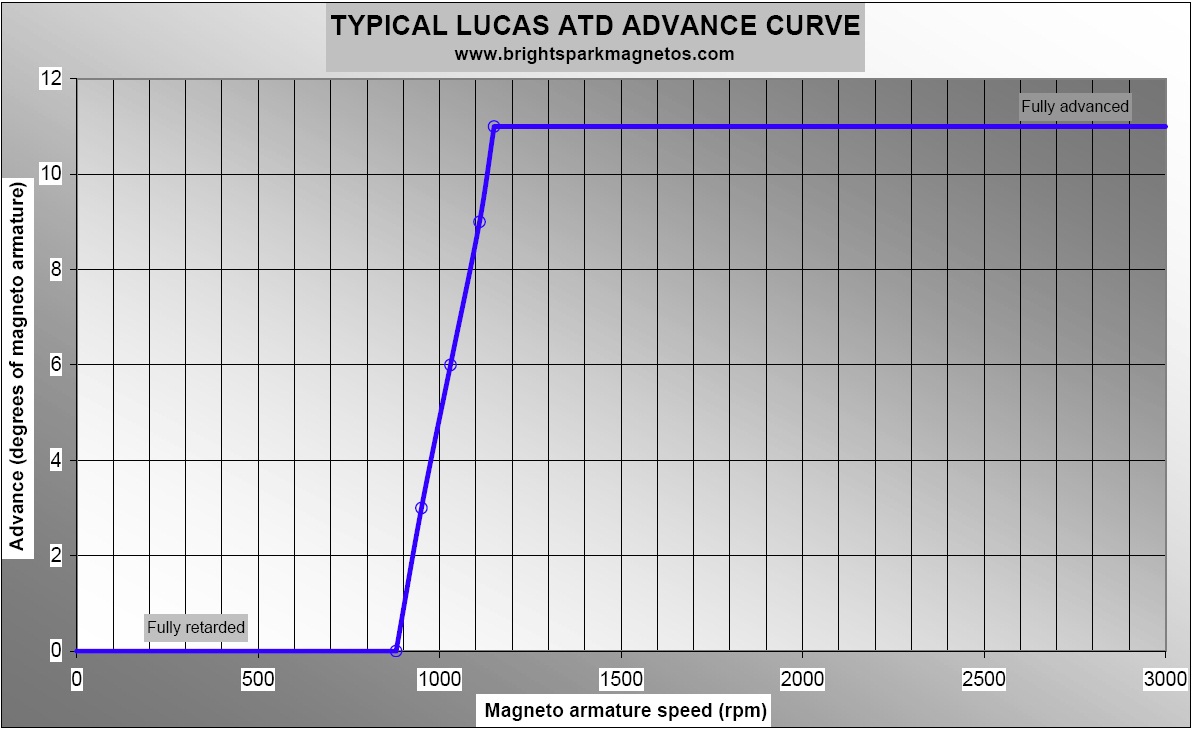
Despite the
complexity, these various forces combine to produce, in a normally functioning
ATD, an extremely simple result, or 'advance curve' as shown in the graph. Below
a particular speed, the ATD stays in its fully-retarded position. Above a
slightly higher speed, the ATD assumes its fully-advanced position. Between
those two speeds, the amount of advance is approximately linearly related to the
speed.
|
 Brightspark Magnetos