|
Before saying anything else on this subject, we ought to say that there may be regulations affecting you regarding suppressors on ignition systems
and/or the generation of radio frequency interference, and that you should check
what regulations apply to you and act accordingly. Having said that, we are
unaware of any prosecutions or complaints in the UK in recent years as a result
of anybody's classic motorcycle magneto causing interference on their
neighbours' radio or television.
The fast electrical current changes in the high-tension part of the ignition
system of a spark-ignition engine can generate nasty radio waves that other
people can find annoying, as a result of which it is customary to fit one or
more suppressors in the ignition system so as to limit the current change rate.
A suppressor can take the form of a discrete resistor in the sparking plug cap,
an in-line fitting in the HT cable, a discrete resistor in the sparking plug
itself, or by the conductor in the HT cable being resistive. A typical value for
the suppressor resistance is 5 or 10 kΩ.
It is often said that you should not fit any form of suppressor in a magneto
ignition system, because the magneto isn't strong enough.
Some time ago we weren't sure whether that is true. A simplified way of looking
at it is this. Until the spark is struck, there is no HT current and so there is
no voltage drop across, or power loss in, the suppressor; therefore, the
suppressor will not affect whether or not a spark is produced. Once the spark
has struck, you are hopefully going to get combustion, and any decrease in spark
power caused by the suppressor is probably going to be insignificant. However,
we weren't sure what really happens and so we did a little experiment with a K1F
magneto running on the Brightspark rig, with and without a suppressor. We were
surprised by the results. We looked
at:
-
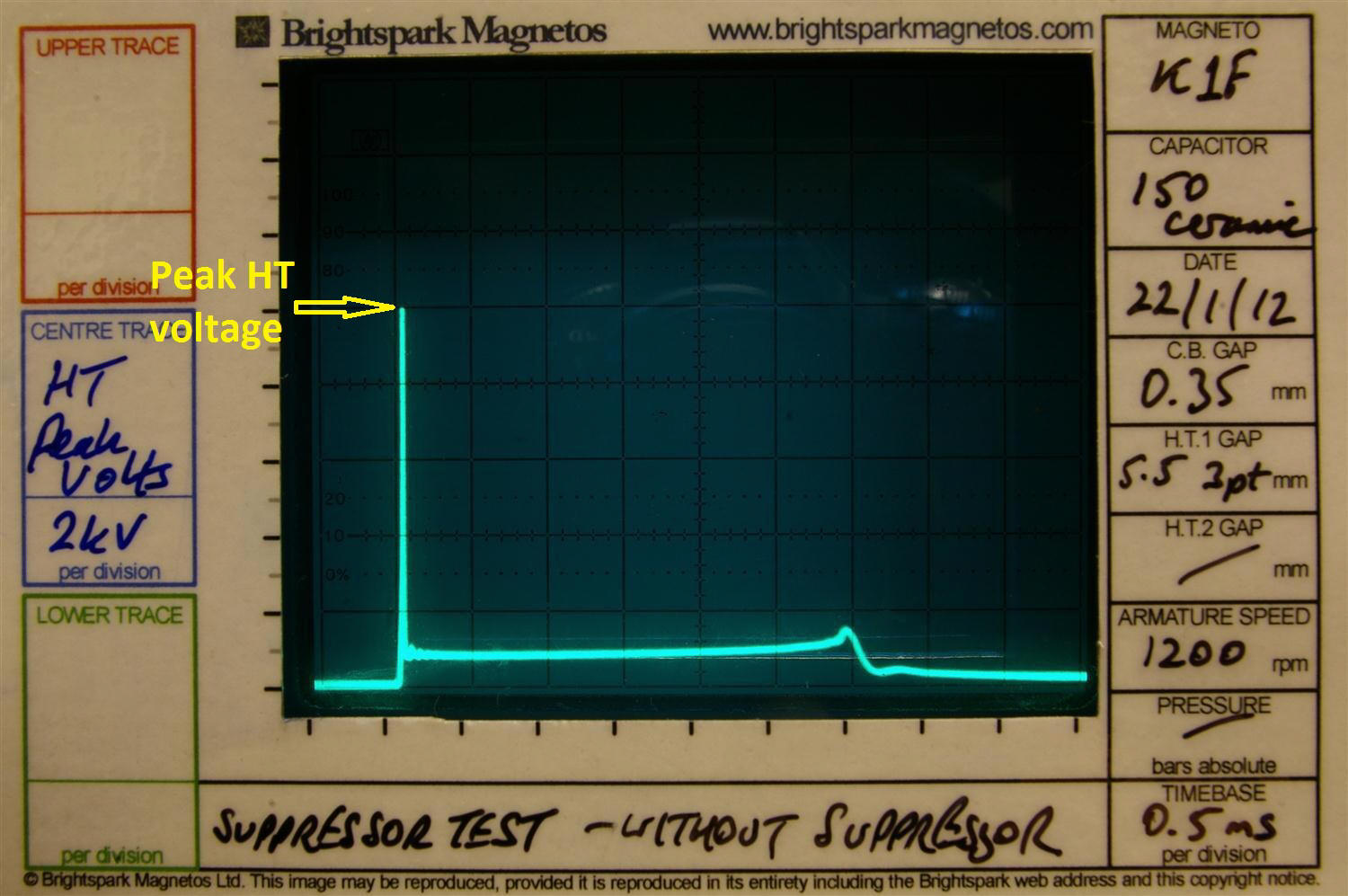
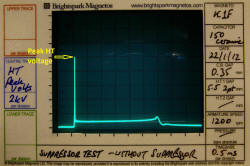
the peak HT voltage just before the spark strikes,
-
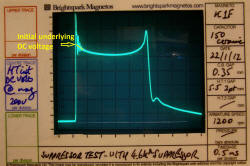
the underlying DC component of the HT voltage immediately after the spark
is struck,
-
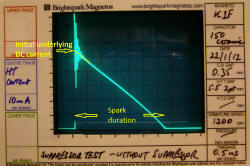
the underlying DC component of the HT current immediately after the spark
is struck, and
-
out of interest, the duration of the spark,
as illustrated in the oscilloscope snapshots below. In the case of the HT
voltages with the suppressor, we looked at them at the magneto (i.e. before the
suppressor) and at the spark gap (i.e. after the suppressor).
|
|
|
|
Peak HT voltage to initiate spark
|
|
|
|
DC component of HT voltage immediately after striking spark
|
|
|
|
DC component of HT current immediately after striking spark
|
|
|
(You can click on the images to increase their size, and then
click the 'back' button in your browser to return here.)
The results are tabulated below. Ignition waveforms can vary from one spark
to another, and each piece of raw data in the table is the mean average of ten
samples taken at random.
|
LUCAS K1F MAGNETO RUNNING AT 1200 RPM AT THE ARMATURE.
5.5 mm (220 thou) THREE-POINT SPARK GAP. |
Without
suppressor |
With 4.6 kΩ
suppressor |
Percentage
difference
with suppressor |
|
Peak HT voltage to initiate spark |
9600 V |
10600 V
at magneto |
10.4 % |
|
9300 V
at spark gap |
-3.1 % |
|
DC component of HT current immediately after striking spark |
53 mA |
52 mA |
-1.8 % |
|
DC component of HT voltage immediately after striking spark |
910 V |
1160 V
at magneto |
27.3 % |
|
850 V
at spark gap |
-6.6 % |
|
Apparent power of DC components immediately after striking spark
(voltage x current) |
48 VA |
60 VA
at magneto |
25.0 % |
|
44 VA
at spark gap |
-8.3 % |
|
Duration of spark |
2.8 ms |
2.5 ms |
-11.1 % |
|
Apparent impedance of suppressor |
|
6.0 kΩ |
|
As you can see, a suppressor does appear to require the magneto to do
considerably more to achieve a significantly poorer spark. Also, note that the
higher the voltages that the HT winding generates, the greater the risk of
breakdown of the insulation of the HT winding.
We're planning in due course to conduct a similar experiment, but with the
magneto running at kickstart speeds.
|
 Brightspark Magnetos