NEWS FLASH - March 2020 As you will understand, with the Covid-19 pandemic shutting down most normal business, we are not able to despatch orders for the time being. Thank you for your patience. We shall resume operations as soon as we possibly can.
Brightspark Magnetos
NEW ...
Take a look
at some of the equipment we use in our workshop for magneto servicing
and overhauls.
If your ignition system is properly set up, the safety
screw(s) shouldn't do anything. However, they are there to provide a
non-destructive path for the HT current in the event that something does go
wrong with the system, such as an HT cable or plug cap coming loose. The
safety screw is earthed and has a tip pointing towards the slip ring, with a
gap between the two. The size of the gap is such that a spark shouldn't jump
between the slip ring and the screw during normal operation, but with a HT
voltage slightly higher than encountered in normal operation, a spark can
jump the gap.
Without a safety screw, the magneto will do its best to get
rid of the energy stored in the LT winding when the CB points open, and it
does that by increasing the HT voltage well above its normal values in an
attempt to find an escape route. Without a safety screw there are many
potential escape routes, such as:
breaking down the insulation of the HT winding and jumping to the
steel of the armature bobbin;
breaking down the insulation of the HT spike and jumping to the
magneto housing (see photo top right);
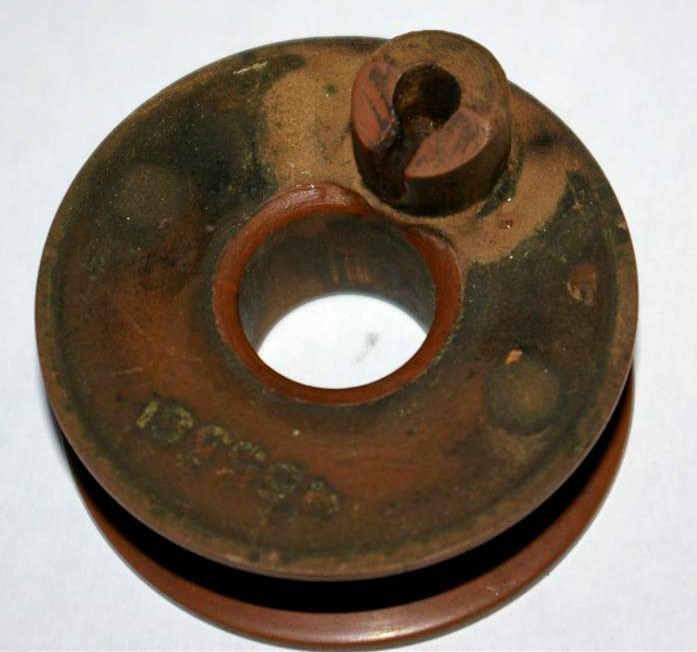
tracking across the boss of the slip ring from the HT spike to the
armature end piece (see photo mid right);
tracking up the sides of the slip ring from the brass segment/ring to
the magneto housing (see photo bottom right and video clip);
finding a crack in the HT pick-up.
Once an escape route has been found, especially if it continues for any
length of time, the damage done is usually irreparable without replacement,
i.e. a bobbin rewind or a new slip ring or pick-up.
In the Brightspark lab, we have a modified K2F magneto with a transparent
acrylic housing for the slip ring. The video clip below shows the lightning
effects that can occur at the slip ring if the HT current can't take its
normal route, in this case because we had disconnected the HT lead and there
were no safety screws.
 Brightspark Magnetos