|
The dV/dt rating of a capacitor is a measure of its ability to cope with
sudden changes in voltage across it, and it is a parameter which is often quoted
for capacitors that are designed for use in pulse and interference-suppression
applications.
For a device which is purely capacitive and has a fixed capacitance, the dV/dt
rating is simply the maximum current (I) that it can take divided by its
capacitance (C). Exceed it, and things are likely to fuse inside the capacitor.
For real capacitors, however, things are not quite that simple. Its capacitance
is not necessarily fixed, and it can be thought of as having a resistance in
series with it, an inductance in series with it, and a resistance in parallel
with it. So, the simple equation dV/dt = I/C becomes only a very rough guide.
In a perfect magneto, the capacitor has a fairly easy time of it dV/dt-wise.
With the CB points closed, a current builds up in the LT winding and there is
zero voltage across the points and capacitor. When the points suddenly open, the
capacitor and windings then start to do their resonant dance, with the voltage
across the capacitor typically initially rising at rate of about 30 to 50 V/µs
towards a first peak of about 200 to 400V. After the oscillations have
died away, the voltage levels out while the spark at the plug is extracting
energy from the system, and then there can be a sizable but leisurely kick in the LT voltage before
it drops to zero as the spark at the plug extinguishes. So, there is perhaps a
maximum dV/dt of 50 V/µs with a perfect magneto, and
if the capacitor were perfect too at 150 nF, it would be handling a maximum
current of 150 nF x 50 V/µs = 7.5 A.
The cam rings of the Lucas K1F and K2F magnetos are designed so that they do
not close while there is any appreciable LT voltage. This is in contrast to a
battery and coil (Kettering) ignition system, where, when the points close, they
short out the capacitor which was previously charged to battery voltage. In that
case, if the points and capacitor were perfect, there would be an infinite
current through the capacitor and an infinite dV/dt across it. Of course, in the
real world, the points, the capacitor and the remainder of the circuit do have
some additional impedance to keep the current and dV/dt to manageable
proportions.
Magnetos are never perfect. With all reasonable sizes of capacitor across the
CB points, the points will occasionally arc a short time after they have opened.
The arc current is sufficient to clamp the voltage across the capacitor back
down to near zero in a very short time - a very high negative dV/dt.
Furthermore, the CB points sometimes do not open cleanly, particularly if the
pivot is dry or loose. We have observed a stuttering or creaky action even in
what appears to be a reasonably good set of points, whereby the points open
(allowing the LT voltage across the capacitor to rise) and then close again,
with a creak, and short the capacitor out in no time at all.
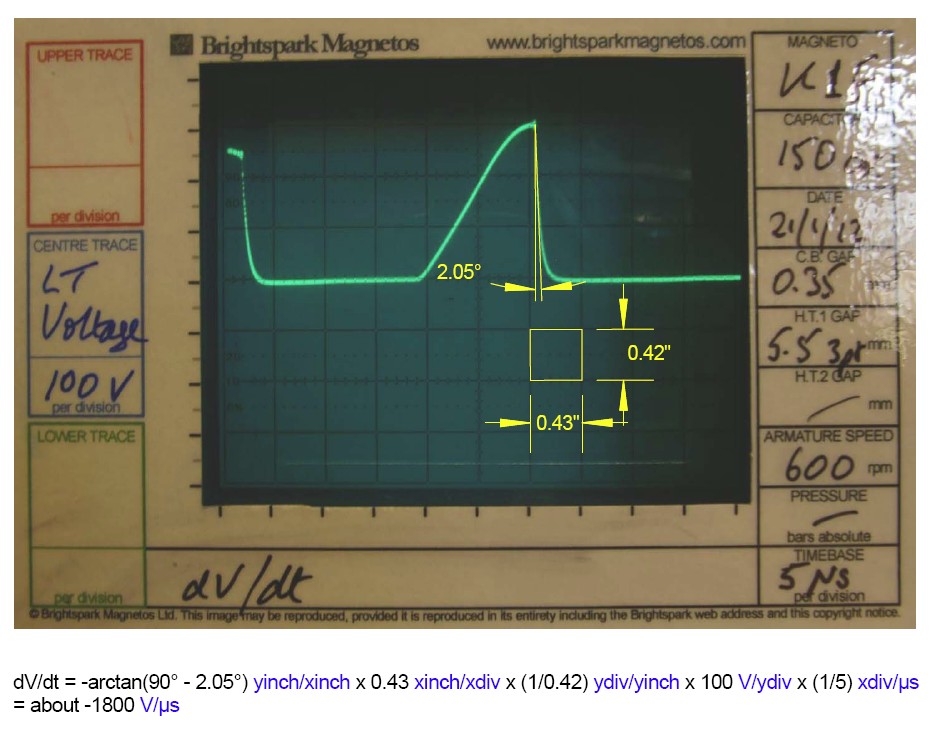
The oscilloscope snapshots above show this effect for a K1F magneto with a
150 nF EasyCap, and the measured-up snapshot on the right reveals a negative dV/dt
of about 1800 V/µs. If one were to apply the
simplistic formula I = C.dV/dt, the current that the capacitor is calculated to
be taking amounts to a massive 270 Amps. We do not know whether the current that
the capacitor is really taking is anywhere near that high, but we strongly
suspect that it isn't.
When all is said and done, dV/dt ratings quoted by
capacitor manufacturers for some of their products apply to the use of the
capacitor in particular circumstances, but we do not know of any capacitor
manufacturer who specifies a dV/dt rating for their capacitor when used in a
magneto.
Going back to the original question, the
manufacturer of the capacitor used in the EasyCap does not specify a dV/dt
rating for it, and we do not know what it might be. What we do know, however, is
that despite our rigorous testing on the road and on our laboratory rig, we have
not been able to make one fail yet.
You can read an interesting paper entitled
"DC, AC and Pulse
Load of Multilayer Ceramic Capacitors" by clicking here.
|
 Brightspark Magnetos