|
Procedure
These notes apply to Lucas K1F, K2F and KVF instruments.
The
outer race of the CB-end bearing is fitted in a recess in the cam housing. A
thick paper insulator has a central annular portion, which fits between the
outer race and the bottom of the recess in the housing, and a number of
radiating fingers which are gripped between the edge of the outer race and
the housing. The insulator prevents any HT current passing through the
bearing.
It is not unusual for the insulator to disintegrate after many
years of service, in which case the outer race may have fallen out when cam
housing was removed from the magneto. However, if still in place, removal is
simple. You will need an old small- to medium-sized flat-bladed screwdriver,
preferably with the last 1/4" of its blade bent through an angle of about 20
degrees. Warm the housing, for example in recently boiled water or with a
heat gun, and then place it in a vice with soft jaws and with the outer race
uppermost. Then insert the blade of the screwdriver into the crack between
the outer race and the bottom of its recess and give it a couple of gentle taps
with a mallet. Reposition the blade just under half a turn around the race,
and give it another couple of taps. You should see the race start to move
up. Keep repeating this until the race is free.
The different bearings have different sizes of insulator. Ensure
you have the correct one. The standard thickness for the insulator is
0.010". Oversize insulators are available, for example with a thickness of
0.013", for use in the case where the recess in the housing has become
oversize due to a loose outer race. However, it is perfectly acceptable to
make do with a standard thickness insulator and masking tape, as described
below.
|
|
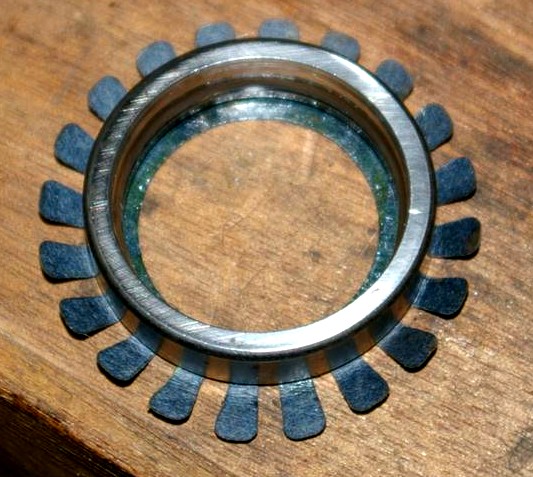 |
Fit the outer race to the balls and inner race to check which is
the outboard face of the outer race that will take the insulator. Remove,
and then carefully glue the insulator to that face of the outer race using
the thinnest of smears of an adhesive such as Evo-Stik. If the insulator has
one shiny side, it should be outermost, i.e. the non-glued side.
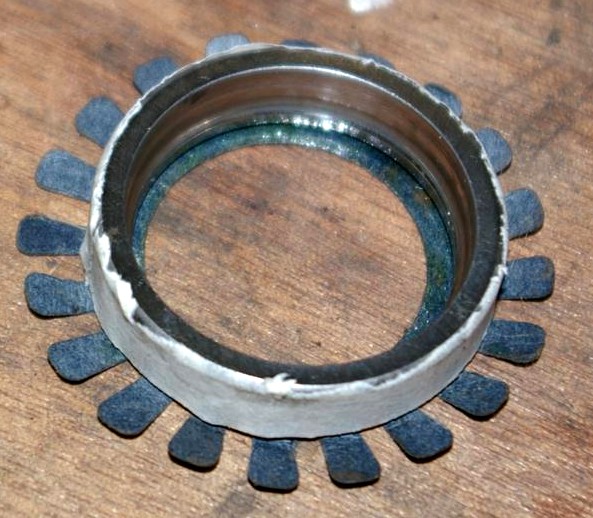
Once the glue is dry, fold the fingers of the insulator over the
outer edge of the outer race.
Ensure that the bearing recess in the cam housing is clean. Then
warm the housing in recently boiled water. Offer the outer race up to the
cam housing so that it starts in its recess. Then place the outer race and
cam housing in a vice with soft jaws and squeeze the outer race home.
|
 |
|
If the outer race slides home freely or with only the lightest of
squeezes, it will be necessary to pack out the insulator. To do this, remove
the outer race and insulator. (If you damage the insulator in the process,
it will need replacing.) Flatten out the fingers of the insulator. Stick one
turn of masking tape neatly to the outer edge of the outer race, and trim it
in width. Then repeat the previous steps . Depending on the thickness of your
masking tape and the amount of oversize of the recess, you may need to do
this more than once to achieve a nice fit.
Once the outer race is home, you may be able to see the tips of the
fingers of the insulator, but none of the fingers should be sticking out
more than the rest. If it does, the insulator has got torn, and you will
need to repeat the whole process with another insulator.
|
 Brightspark Magnetos