|
The 'quick snip' procedure entails electrically
disconnecting the original condenser without disassembling the armature, and leaving it in place buried in the
armature. By comparison, the 'complete works' entails disassembling the
armature.
If you need to disassemble the armature to
have the bobbin rewound, then you should do a
'complete works' condensectomy.
In the case of the Lucas MO1, MN2 and N1 instruments and the BTH
instruments, the 'quick snip' procedure is
not possible, and you'll need to perform the
complete works.
In the case of a Lucas K1F, K2F or KVF instrument:
The quick snip isn't always possible,
but if it is then you should try it in preference to the complete works.
With the complete works, there is probably a greater risk of damaging the
wires where they come out of the bobbin necessitating a rewind.
Hold the armature with the drive-end in your left hand, the
CB-end in your right hand, and the HT wire that goes from the bobbin into
the boss on the slip ring furthest away from you (hidden at the rear). At
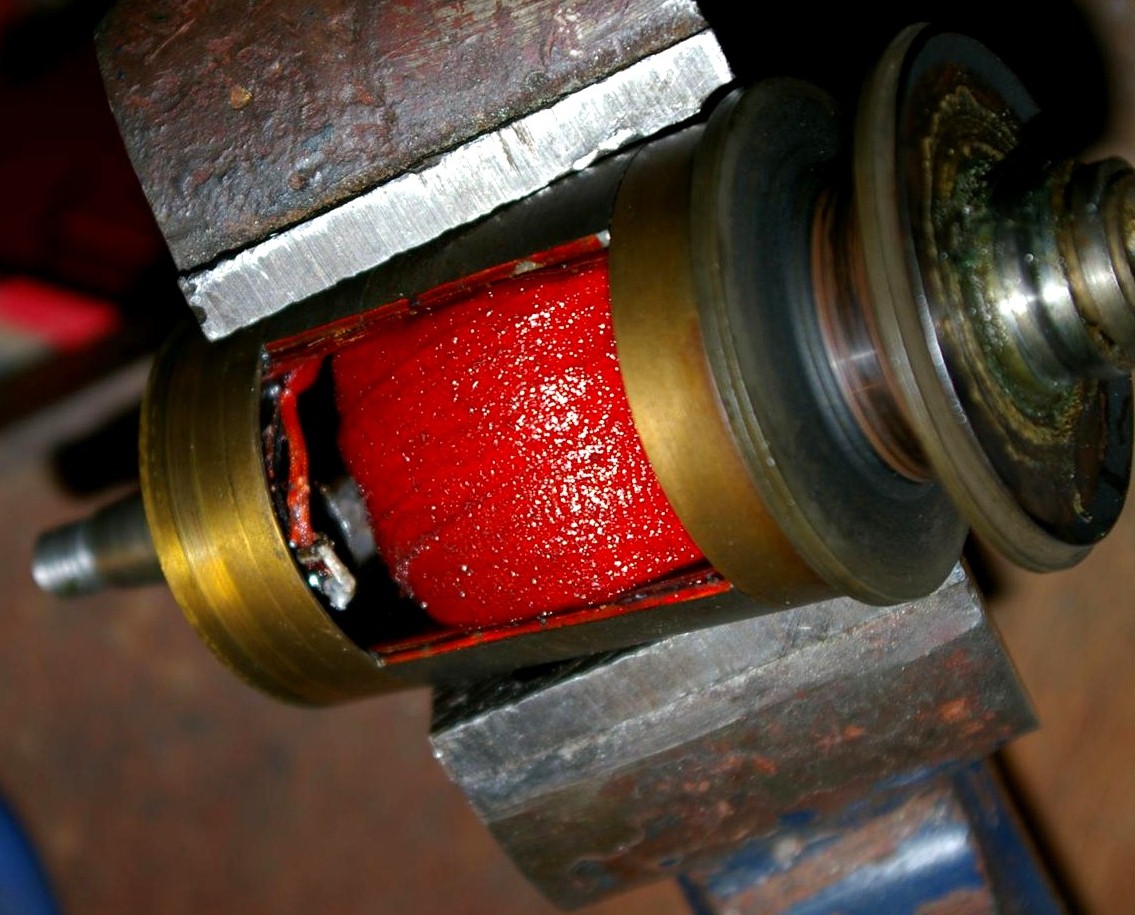
the top of the gap between the bobbin and the brass drive-end end-piece, you
should see a wire sheath coming out of the end of the bobbin. There are two
wires inside the sheath, and they are connected to the live side of the
existing condenser. You may be able to see the condenser, or it may be
potted in a lump of resin. Ask yourself: Have I got the tools and is there
enough room so that I can:
-
disconnect the wires from the condenser or snip through the sheath,
-
ensure that the disconnected wires remain electrically connected to
each other and solder them if necessary, and
-
insulate the disconnected ends so that they don't make electrical
contact with anything else?
If the answer is "yes", you can try the quick
snip. Otherwise, you'll need to perform the
complete works.
|
 Brightspark Magnetos