|
|
Replacing the insulator for the drive-end bearing outer
race and/or the oil seal
|
|
|
Special tools/materials required
-
Suitable diameter drift if the outer race has not fallen out
-
Oil seal (not used with MO1)
-
Insulator
-
Contact adhesive (e.g. Evo-Stik, or similar)
-
Possibly masking tape
|
|
|
Procedure
The
outer race of the drive-end bearing and a disc-shaped oil seal are fitted in
a recess in the main housing. A thick paper insulator has a central annular
portion, which fits between the outer race and the oil seal, and a number of
radiating fingers which are gripped between the edge of the outer race and
the housing. The insulator prevents any HT current passing through the
bearing. As far as we are aware, none of the versions of the MO1 and MN2 had
an oil seal.
|
|
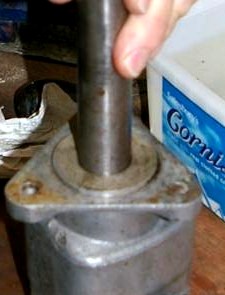 |
It is not unusual for the insulator to disintegrate after many
years of service, in which case the outer race and oil seal (if present) may have fallen
out when the armature was removed from the housing (although they may still
be inside the housing, stuck to the magnetic pole pieces). However, if still
in place, warm the housing in recently boiled water. Then
insert a snugly fitting drift from the outside through the
drive-end hole of the housing against the oil seal and tap it with a hammer
or mallet. For the K-series magnetos, a 1 inch or 25mm diameter drift may be
used, and an 11/16"AF 1/2"-drive socket may well do the trick. The race, insulator and oil seal will usually fall out. If not,
then you will need to try the method shown in Fig. 7 of the relevant
Lucas Workshop Instructions.
We strongly recommend always using a new insulator and never
re-fitting an old one. Also, oil seals do not last forever. Having got this
far, there is a lot to be said for fitting a new oil seal, whether or not
the old one seems good.
The different bearings have different sizes of insulator. Ensure
you have the correct one. The standard thickness for the insulator is
0.010". Oversize insulators are available, for example with a thickness of
0.013", for use in the case where the recess in the housing has become
oversize due to a loose outer race. However, it is perfectly acceptable to
make do with a standard thickness insulator and masking tape, as described
below.
|
|
|
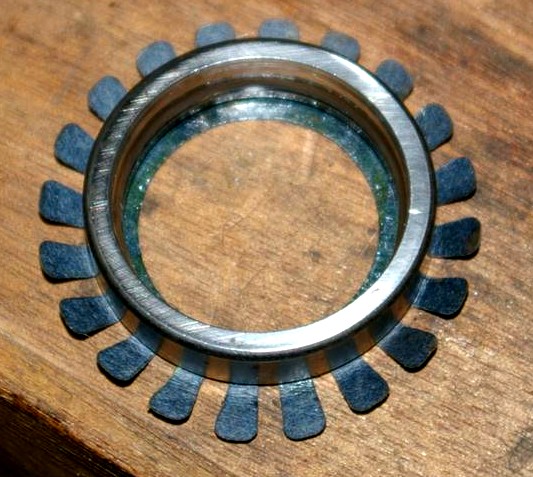
Fit the outer race to the balls and inner race to check which is
the outboard face of the outer race that will take the insulator. Remove,
and then carefully glue the insulator to that face of the outer race using
the thinnest of smears of an adhesive such as Evo-Stik. If the insulator has
one shiny side, it should be outermost, i.e. the non-glued side.
Once the glue is dry, fold the fingers of the insulator over the
outer edge of the outer race. Then replace the outer race on the inner race
and balls, followed by the oil seal, if used, with its lip spring outermost.
Ensure that the bearing recess in the housing is clean. Then warm
the housing in recently boiled water. With the armature vertical and the
drive-end uppermost, lower the housing over the armature so that the outer
race starts in its recess. Invert the whole thing and, with the housing
supported over an open vice, push the outer race home using a block of wood
over the CB-end of the armature. It should go with a hard push by hand, or
with a few moderate taps with a
mallet.
If moderate taps aren't sufficient, do not hit harder - you don't
want to damage the drive-end bearing races or the armature - but instead
remove the armature, and drive the outer race home with a drift (a 5/8"
Whitworth, 1-3/16" AF or 26 mm 1/2"-drive socket on a 6" extension bar
should do the trick), while at the same time ensuring that the oil seal
stays on-centre. It should not take much effort to drive the race home, and
care needs to be taken not the break away the lip of the main body of the
magneto behind the race.
|
 |
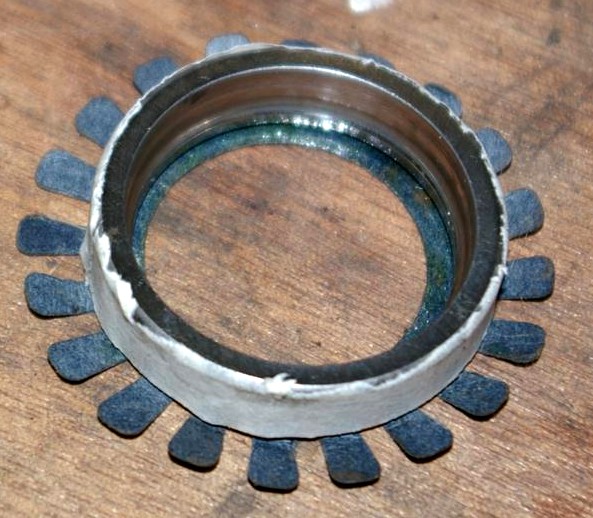 |
If the outer race slides home freely or with only the lightest of
taps, it will be necessary to pack out the insulator. To do this, remove the
outer race, insulator (and oil seal). Flatten out the fingers of the
insulator. Stick one turn of masking tape neatly to the outer edge of the
outer race, and trim it in width. Then repeat the previous steps. Depending
on the thickness of your masking tape and the amount of oversize of the
recess, you may need to do this more than once to achieve a nice fit.
Once the outer race is home, the oil seal, if present, should be firmly gripped
between the outer race and the housing. Also, looking inside the housing,
you may be able to see the tips of the fingers of the insulator, but none of
the fingers should be sticking out more than the rest. If it does, the
insulator has got torn, and you will need to repeat the whole process with
another insulator. |
|
|
|
|
|
 Brightspark Magnetos